
The CNC machining process combines digital CAD design, advanced CAM software, and automated equipment such as CNC mills, CNC lathes, and CNC machining centres to produce precision-engineered components with exceptional consistency. Every stage, from creating a CAD model to machining the final product, plays a critical role in ensuring accuracy, efficiency, and repeatability.
This guide explains how CNC machining works and why it has become a trusted manufacturing solution for Australian industries.
Key Takeaways:
- The CNC machining process follows a structured workflow: Every project moves through key stages, including CAD design, CAM programming, machine setup, automated machining, and quality inspection to produce an accurate finished component.
- Digital CAD design drives manufacturing precision: CAD and CAM software work together to convert engineering drawings into machine-readable instructions, ensuring consistent results and tight tolerances.
- Proper machine setup is critical: Selecting the right tools, securing the workpiece, and calibrating the machine all help minimise errors and improve production efficiency.
- Modern CNC machining delivers repeatable quality: Computer-controlled equipment enables manufacturers to produce complex parts with high accuracy, making CNC machining suitable for prototypes as well as high-volume production.
How the CNC Machining Process Works
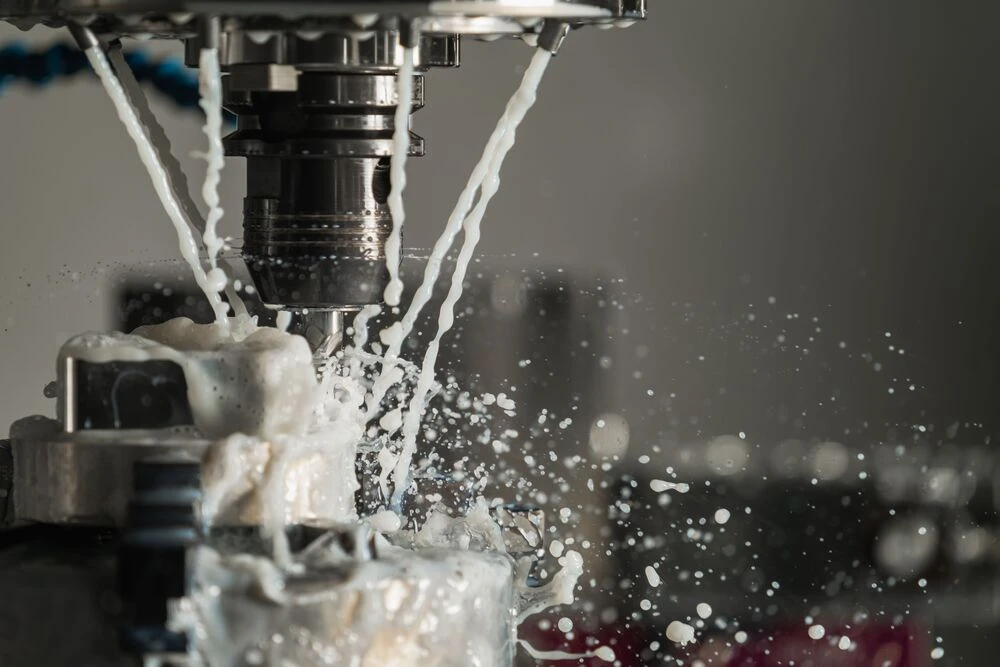
In Australian manufacturing, CNC machining is valued for its accuracy and repeatability. It is a subtractive process in which pre-programmed computer software directs the movements of the cutting tools and machinery, removing material to shape each part with precision.
This technology exists primarily to automate cutting, drilling, and shaping tasks that are impractical, or impossible, to perform consistently by hand.
Numerical Control (NC) emerged in the late 1940s and 1950s, driven by punched-tape instructions. As digital processors became faster and cheaper, NC gave way to computer numerical control (CNC) in the 1960s and 70s – the automated CNC machining process used today. Australian workshops rely on these systems to produce identical parts to tight tolerances, run after run.
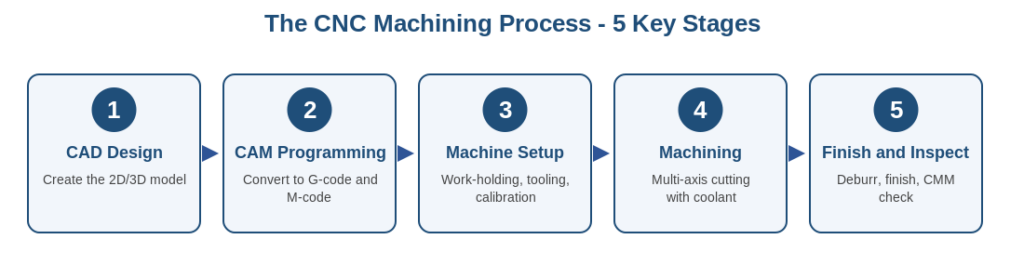
5 Key Steps of the CNC Machining Process
Beginning with new ideas and moving to finished products is an orderly sequence of events. Knowledge of these stages and their interactions would help companies determine at what point production takes place, what kind of material to use, and how to acquire it.
Step 1: Creating a CAD Drawing
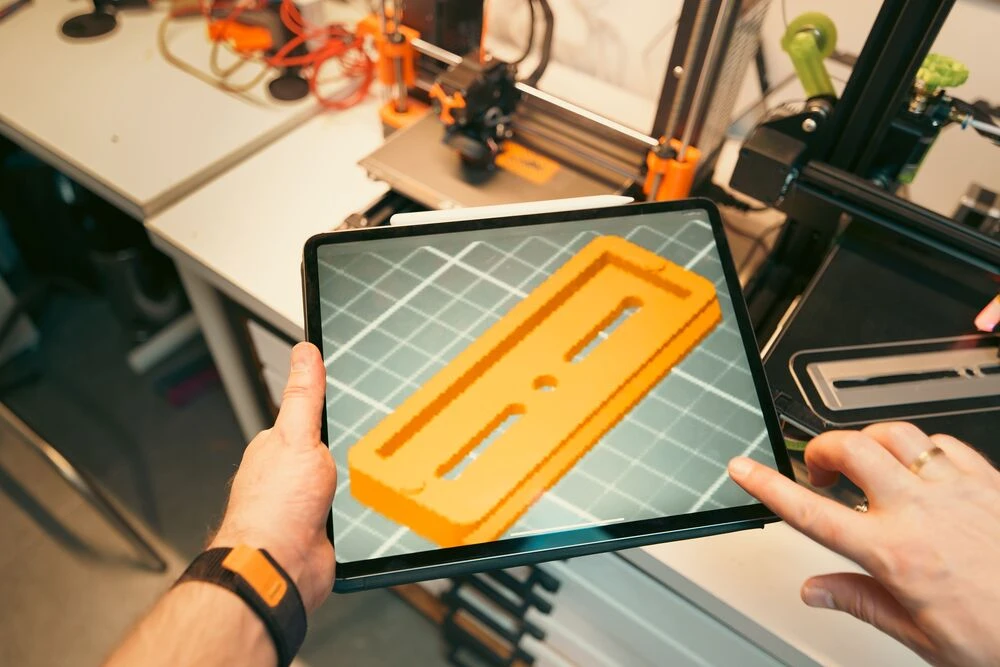
All of the assembly starts in sketch form on the computer (CAD drawings). The finished product is built from this original computer-generated 2D or 3D drawing, which gives the specifications (length, width, height, and other such details) of the component.
The computer drawing serves as the geometry for the whole project. It helps in ensuring that when the component is finally manufactured, it perfectly matches the design requirements.
Step 2: Conversion of CAD File to CNC Codes
A machine cannot read a standard design file directly. CAM software interprets the CAD geometry and translates it into the codes known as G-code and M-code.
The codes represent instructions that tell the machine the locations and directions to cut, rotate at what speed, and perform many other operations.
Step 3: Preparation of the Machine
Before pressing any button to start the task, the machinist must do the necessary physical preparation. This involves clamping the workpiece made of raw material in the vice, placing the proper cutting tools in the machine spindle, and calibrating the machine coordinates so that the machine head will know its exact position in 3D space.
Step 4: Machining Process Execution
After the machine is ready for action, the computer software will take total command of the operation. The machine will perform all the instructions programmed into it, using advanced procedures like CNC milling that will be responsible for removing any excess material from the block.
The machine moves along multiple axes simultaneously, while coolant is delivered to the cutting zone to manage heat and protect tool life.
Step 5: Finishing and Quality Inspection
Once cutting is complete, parts are deburred, cleaned, and given any required surface finish, such as bead blasting, anodising, or plating. Each component is then inspected against the original CAD specification using precision measurement tools, including calipers, micrometers, and coordinate measuring machines (CMM), to confirm it sits within tolerance.
Full dimensional records and material traceability are retained throughout, giving clients documented proof of conformance and a reliable audit trail for quality-critical applications.
Why Australian Companies Rely on Quality Manufacturing Processes
Engineering jobs have varying specialisations. When dealing with complex shapes or rotating parts, state-of-the-art facilities use advanced manufacturing technology to achieve precise results.
Seeking CNC machining services means having your engineering work done in an industrial facility with machinery rated for demanding engineering metals and plastics such as stainless steel, titanium, aluminium, Delrin, and PEEK. In order to be competitive internationally, these processes are well in line with the standard set forth by professional bodies such as Engineers Australia.
Collaborate With Rahi Engineering for Your Upcoming Project
A custom production run needs an experienced partner who understands the stringent parameters your application demands. Rahi Engineering delivers reliable, high-precision machining tailored to your project, with experienced staff overseeing every stage from setup to final inspection – whether you need a one-off prototype, a low-volume run, or full-scale production, all from our local Australian workshop.
Ready to start? Contact Rahi Engineering today for a quote.
Frequently Asked Questions
What is the difference between CNC machining and 3D printing?
CNC machining is a subtractive process: it starts with a solid block of material and cuts away everything that isn’t part of the finished component. 3D printing is additive: it builds a part up layer by layer. CNC generally offers tighter tolerances, superior surface finishes, and a wider range of engineering-grade metals, while 3D printing suits highly complex geometries and rapid concept models.
What tolerances can CNC machining achieve?
Standard CNC machining typically holds tolerances of around ±0.05 mm, with precision work achievable to ±0.01 mm or tighter depending on the material, part geometry, and machine. Tell us your critical dimensions and we will confirm what is achievable for your job.
Which materials can be CNC machined?
A broad range of metals and engineering plastics can be machined, including aluminium, stainless steel, titanium, brass, and tool steels, along with plastics such as Delrin (acetal), nylon, and PEEK. Material choice depends on the part’s strength, temperature, and wear requirements.
How long does a CNC machined part take?
Lead time depends on complexity, material availability, and quantity. Simple prototypes can often be turned around in a few days, while larger production runs are scheduled around volume and finishing requirements. Contact us with your drawing for an accurate lead-time estimate.
